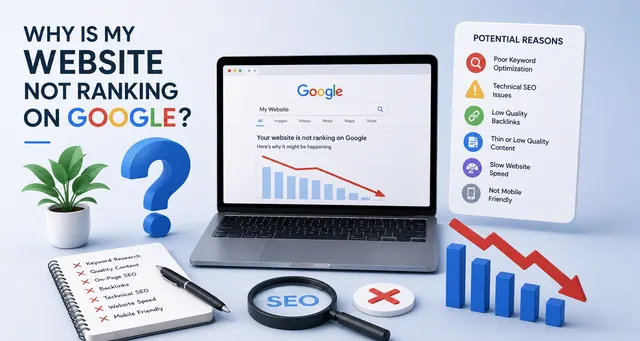
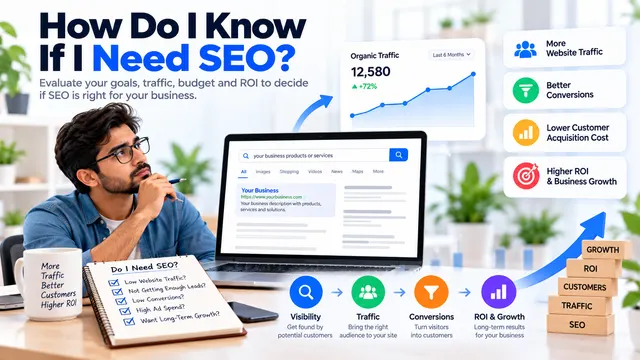
Most SEO that fails doesn't fail because Google is mysterious. It fails for a handful of ordinary reasons: the work targets the wrong searches, the website has a technical problem nobody checked, the content says nothing a customer can use, or the business stops after three months because nothing moved. Each of these is avoidable if you know to look for it before you spend money.
Here is what usually goes wrong, roughly in the order it tends to happen, and what to do instead.
Chasing keywords nobody who buys from you types
The first mistake is picking keywords because they have big search volume or because the owner likes how they sound. A packaging manufacturer in Noida wants to rank for "packaging". A dental clinic wants "best dentist in India". Neither search is likely to bring in a customer they can actually serve.
The searches worth your effort are the ones a buyer types when they're close to deciding: "corrugated boxes manufacturer Noida", "root canal treatment Dwarka", "GST billing software for wholesalers". They have far less volume, but the people typing them want what you sell, in the place you sell it.
Before any work starts, write down ten or fifteen phrases your actual customers would use, then check them in Google Search Console (if your site already has some traffic) or in the free keyword ideas inside Google Ads Keyword Planner. Ask your sales team what words customers use on the phone. That list is more reliable than any tool's guess.
A website that Google can't read properly
A surprising amount of SEO effort goes into sites with a basic technical fault that blocks everything else. The common ones:
- Pages blocked from indexing. A noindex tag or a robots.txt rule left over from the staging site tells Google to stay away. It happens after redesigns more often than you'd think.
- Every page with the same title. If your home page, service pages and contact page all have the title "Home | Company Name", Google has little to go on.
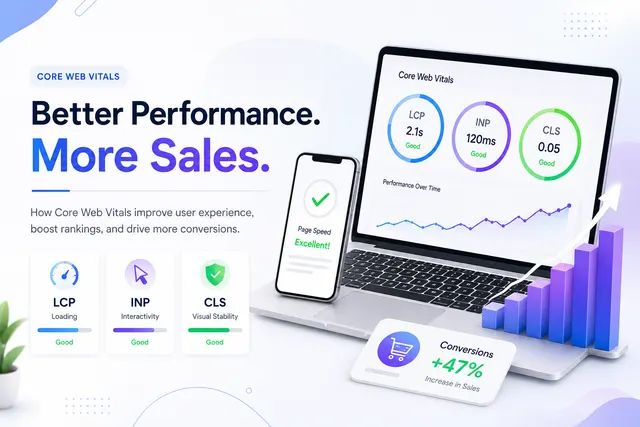
- Slow pages on mobile. Google uses Core Web Vitals as one of its page experience signals. They measure loading (LCP), visual stability (CLS) and responsiveness (INP, which replaced FID in March 2024). Heavy sliders, uncompressed images and too many plugins are the usual causes.
- Content hidden behind scripts. Some site builders and badly configured JavaScript frameworks load text only after the page runs code. Google can often render it, but not always reliably.
- Broken redirects after a redesign. When a new site goes live and old URLs return a 404 instead of redirecting to the new page, the rankings those old pages had are lost.
Google Search Console is free and shows most of these: which pages are indexed, which are excluded and why, and how your pages do on Core Web Vitals. Set it up before you pay anyone for SEO. If the site itself is the problem, fixing the build is usually cheaper than working around it; that's the kind of job our website development team handles.
Thin pages written for search engines, not people
The old habit of repeating a keyword as many times as possible still shows up. So do pages for every locality ("web design in Lajpat Nagar", "web design in Saket", and so on) with the same text and only the place name swapped. Google is good at spotting both, and visitors leave quickly when a page doesn't answer their question.
A service page that ranks and converts usually answers what a buyer actually asks: what exactly you do, who it suits and who it doesn't, how the process works, how long it takes, what affects the cost, and what they need to provide. Photos of real work, named project types and a clear way to get in touch do more than a block of keywords.
The same goes for a blog. One useful article that answers a real customer question is worth more than twenty generic posts on topics every agency covers. If you publish, write about the questions your sales team hears every week.
Ignoring local search
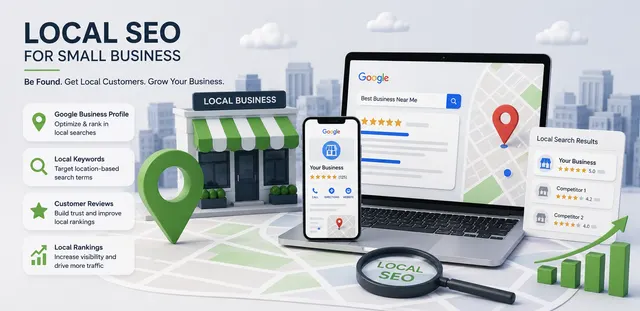
For most small businesses in India, the searches that matter are local. Someone searching "AC repair near me" sees the map results before the regular listings, and those come largely from Google Business Profile (it used to be called Google My Business).
The common problems here are simple: a profile that was never claimed, the wrong category, an old phone number, opening hours that are out of date, or a business name, address and phone number that differ between the profile, the website and directories like Justdial. Fix the basics, add real photos, and ask happy customers to leave reviews. Reply to reviews, including the bad ones, calmly.
Don't buy reviews or ask staff to post them. It breaks Google's policies and can get reviews removed or the profile restricted.
Buying links and shortcuts
Offers of "500 backlinks for a small fee" land in every business inbox. Those links usually come from spam sites, link farms or blog networks, and Google's spam policies specifically cover link schemes. At best they do nothing. At worst they can lead to a manual action, which you would see in Search Console, and cleaning that up takes time.
Links that help come from places a real person would follow: an industry association listing, a supplier or partner who mentions you, a local news story, a useful guide that others cite. They're slower to earn, and that's the point.
Expecting results in weeks, then stopping
SEO is slow. Google has to crawl the changes, and rankings for competitive searches shift gradually. Nobody can tell you an exact timeline, and anyone who guarantees a first-page ranking is promising something they don't control. Google says as much in its own guidance on hiring an SEO.
The pattern that wastes the most money is starting, seeing little in the first couple of months, and cancelling just as the work was starting to show. If you can't commit to giving it a reasonable run, you're often better off putting that budget into Google Ads for now, where you pay per click and see results quickly, and coming back to SEO later.
Measuring the wrong thing
Monthly reports full of "keyword positions" and "domain authority" scores tell you very little about the business. A ranking for a phrase nobody searches is worth nothing. A third-party authority score is not something Google uses.
Track what connects to money:
- Clicks and impressions from Google Search Console, for the searches you chose at the start.
- Enquiries from organic search: form submissions, calls and WhatsApp clicks, tracked in Google Analytics 4 as key events.
- Which of those enquiries turned into customers. Your sales team or CRM has this, and it's the number that tells you if SEO is paying for itself.
If your agency can't show you these, ask why.
How to avoid most of this
A short checklist before you spend:
- Set up Google Search Console and Google Analytics 4 and look at what's already there.
- Agree on a list of buyer searches, by service and by location.
- Fix technical problems first: indexing, titles, speed on mobile, redirects.
- Make each service page answer the questions a buyer would ask.
- Claim and complete your Google Business Profile.
- Decide what you'll measure and how often you'll review it.
- Commit to a realistic period before judging the results.
You can do some of this yourself. If you'd rather hand it over, our SEO service starts with an audit along these lines, and the pricing calculator gives you a rough estimate before you talk to anyone.